

 Slovak
 Hungarian
 Polish
 German
 Spanish
Logbooks
The paper logbook written up every December is over
 Help
Help
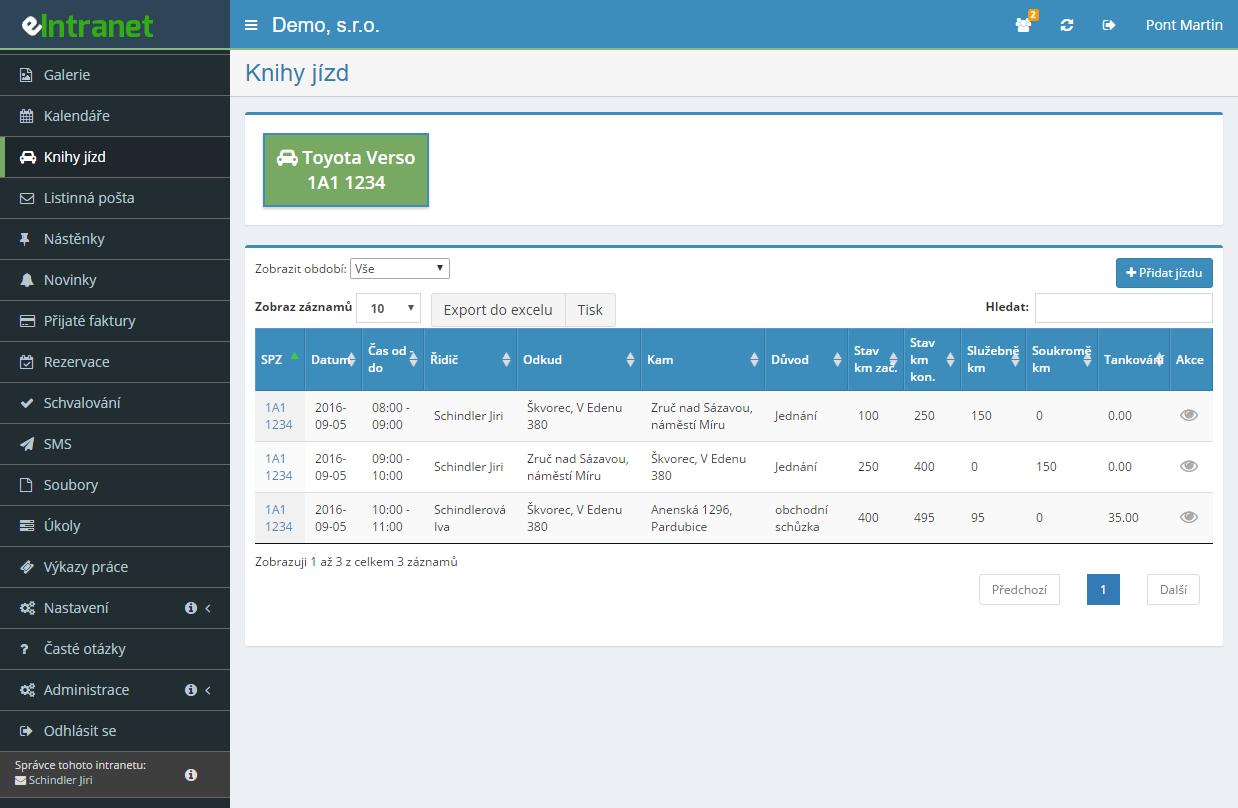
The logbook in eIntranet handles passenger cars, heavy goods vehicles and working machines – for machines it records hours worked instead of kilometres. Every vehicle gets its own overview and its own list of drivers.
Pick From and To and the system supplies the distance from the last trip along the same route. The opening odometer reading follows on from the previous record, and the start time from the end of the previous trip.
Enter the litres and the odometer reading fills in by itself. After the next fill-up the system works out the average consumption across the whole stretch between the two tanks.
Set a rate per kilometre, per hour or a flat amount per trip. The overview by job then totals the kilometres, hours and value, and you add the number of the invoice you issued.
What you can use the logbook module for
-
Three views of the same data
The driver sees the trips of their own vehicle, the administrator sees every vehicle in one table, and whoever raises invoices gets the overview grouped by job.
-
Overlapping trips are rejected
If a new trip clashes in time with one already recorded, the system refuses it. One car cannot be in two places at once.
-
Push a trip into a travel order
Click the arrow beside a trip, pick a travel order, and the route, distance, date and times transfer into it as a finished line.
-
Warning when a service is due
Saving a trip compares the odometer against the service interval held in the vehicle register. An overrun is flagged immediately, not at the annual inspection.
-
Export to Excel and print
Filter a month and download the XLSX for your accountant, or open the printable logbook layout.
The electronic logbook is a key tool for efficient tracking and management of company vehicles. Move the traditional paper log into the cloud, where data remains securely stored, easily accessible, and always up-to-date.
Main benefits:
- Recording trips for both personal and commercial vehicles or equipment – all in one system without paper forms.
- Setting invoicing rates based on vehicle type, trip type, or rate tables, eliminating errors from manual calculations and saving up to 30 % of accounting time.
- Trip overview by assignment – quick generation of reports for cost control per project or customer, ideal for audits and internal analysis.
- Automatic backup and audit trail – data is protected against loss and can be easily verified for compliance with legal requirements.
- Integrated alerts for exceeding mileage limits or planned expenses, helping prevent unplanned costs.
Save time, reduce errors, and gain full control over operating costs. Call us today to find out how an electronic logbook can move your business forward.
Frequently asked questions
The vehicle has no initial odometer reading in its settings. The first trip has nothing to follow on from, so the field stays empty. Go to Settings → Vehicles, find the vehicle and enter the current odometer reading.
From then on the opening reading fills in automatically from the last recorded trip.
Because no drivers are assigned to the vehicle. Without at least one driver the system will not let a trip be saved and hides the button.
The fix: Settings → Vehicles, open the vehicle and add the users allowed to drive it under Vehicle drivers. It is the most common snag on day one.
Yes. Each vehicle is given a type: passenger car, TIR or machine. On passenger cars kilometres split into business and private, on TIR the private portion is not recorded, and on machines hours worked are counted instead of kilometres.
The hours are derived automatically from the trip's time interval and are billed at the hourly rate you set on the vehicle.
No. The Logbooks module does not work with GPS units directly. Vehicle tracking in eIntranet is handled by the separate GPS location module, which is the only one requiring its own hardware and is paid on top of the subscription.
Recording trips in the logbook is manual, but with a memory – the system prefills route, distance and times from history. For regular routes there is also an automatic monthly fill.
The trip you are entering overlaps in time with another already recorded trip of the same vehicle. It is a deliberate check that prevents an inconsistent record.
Find the conflicting trip in the table and adjust the times so they follow on from each other. Most often it is a typo in the end time of the previous trip.
Usually because there has only been one fill-up so far. Consumption is worked out from the second fill-up onwards – the system needs two points between which to measure the distance.
Check as well that the litres field is filled in and greater than zero and that the odometer reading at the fill-up is right. For an accurate result the tank has to be filled completely every time; a partial fill will not give a precise figure.
Only partly. The job, purpose and note can always be changed. Date, time, route and distance only on the last record and only within the number of days back set by the vehicle administrator.
The module administrator is not bound by these limits and can edit any record – but when touching an older trip they have to watch the continuity of the odometer readings against later trips themselves.
Only the last recorded trip of a vehicle can be deleted. That protects the continuity of the odometer readings. If another trip has been recorded after yours, you have to remove the newer one first.
The second possible reason is permissions: deletion is allowed for the driver who entered the trip, the driver who made it, the logbook administrator and the module administrator.
Yes, but an administrator has to enable the function on the vehicle first. A button for preparing the monthly fill then appears in the logbook.
In the wizard you enter favourite addresses and how often they occur (daily, weekly, at the start or end of the day, or at random), the opening and closing odometer readings, the fuel level, and the working days with working hours. The generated records need reviewing – they are a skeleton, not a finished logbook.
That view shows only trips that have a job filled in and belong to a vehicle with billing enabled. If no billing rate is set on the vehicle, its trips will not appear in the overview.
Check the filters as well – too narrow a period, a specific vehicle or a specific driver can exclude every record.
Yes. In the trip table click the right-arrow icon beside the trip and pick an existing travel order or create a new one.
The route, distance, date and times transfer into the travel order as a finished line and the link between the trip and the order is preserved. That removes the second entry of the same details.
Per user. The number of vehicles in the module is unlimited and has no effect on the price. A company with twenty cars and six drivers pays for six users.
The Logbooks module is not charged separately – it is part of the subscription like every other module, and it needs no hardware.
Registration is non-binding and includes a free 14-day trial of the application.